

PRP Hair Treatment in Lake Havasu City
- Treatment Time:
- 60 minutes
- Downtime:
- 24 hours
- Series:
- 3 monthly sessions
- First Results:
- 3 to 4 months

Regenerative Hair Care
Personalized PRP Hair Treatment Planning
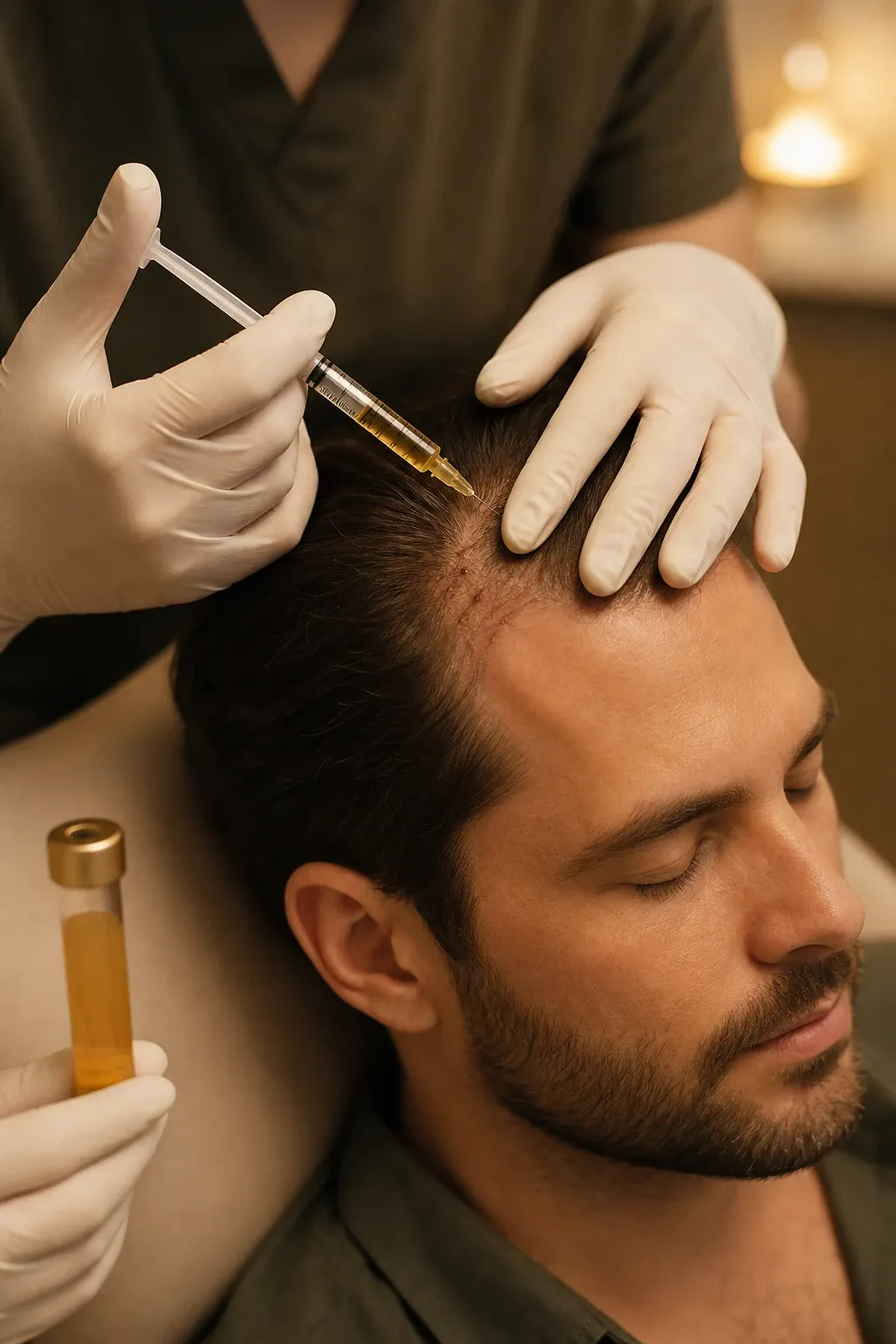
PRP hair treatment in Lake Havasu City, AZ, serving Havasu Foothills Estates, Desert Hills, the Riviera, Crystal Beach, Parker, Bullhead City, Kingman and the surrounding Mohave County communities, concentrates the platelets from your own blood and injects them into thinning scalp to stimulate weakened follicles.
Your plasma is prepared and injected by our medical director with more than 30 years of medical experience and 32 years in Lake Havasu City, or by our nurse practitioner injector, who brings 18 years of clinical practice. Our registered nurse handles the blood draw.
Why It Matters
When Thinning Hair Calls for PRP Hair Treatment
Understanding Follicle Miniaturization
Hair loss rarely announces itself. It shows up as a part that keeps widening, a ponytail that needs an extra wrap, more strands in the shower drain than you remember, or a scalp that reads through under bright light.
Genetics and dihydrotestosterone drive most pattern loss, but thyroid changes, low iron, menopause, postpartum hormone shifts and stress all push follicles into an extended resting phase. Havasu's low humidity and hard summer sun add breakage on top of it.
PRP hair treatment works on follicles that are shrinking but still alive. We draw a small amount of your blood, spin it to concentrate the platelets, then inject that plasma across the thinning zones so the growth factors sit where the follicle needs them.
The aim is to slow shedding first, then thicken the shafts that are still producing. It is a course of care rather than a single fix, and we screen honestly for who is likely to respond before you commit to a series.
Understanding Your Treatment
What Is PRP Hair Treatment?
The Science of Platelet Rich Plasma
PRP hair treatment uses platelet rich plasma, a concentrate from your own blood, to treat thinning hair and pattern hair loss. The centrifuges that prepare it are FDA cleared devices, but PRP is not an FDA approved drug for hair loss, so scalp injection is off label. The American Academy of Dermatology calls it an adjunct.
Platelets carry growth factors. Placing them around shrinking follicles is meant to improve blood supply and extend the growth phase so resting follicles restart. Density follows the hair cycle, so the protocol is three monthly sessions plus maintenance, usually with scalp microneedling for thinning hair.
Treatment Timeline:
- First Signs:
- 3 to 4 months (shedding slows first)
- Full Effect:
- 6 to 12 months (with maintenance visits)
- Treatment Time:
- 60 minutes (including the blood draw)
- Recovery:
- 24 hours (scalp may feel tender)
What We Treat
Hair Concerns PRP Hair Treatment Addresses
Where Scalp Injections Help Most
- Crown Thinning
- Density loss at the vertex in both men and women
- Widening Part
- Often the first visible sign of female pattern hair loss
- Early Recession
- Temple and hairline thinning caught before follicles are lost
- Diffuse Shedding
- Telogen effluvium after illness, stress or rapid weight loss
- Postpartum Hair Loss
- Shedding that follows pregnancy and the hormone shift after it
- Desert Scalp Stress
- Weak shafts and poor circulation worsened by heat and dry air
Benefits of PRP Hair Restoration
Your Own Biology, Concentrated
PRP Hair Treatment vs. Other Hair Loss Options
PRP works on living but weakened follicles. It supports medical therapy rather than replacing it, and it cannot regrow hair from scarred scalp.
| Treatment | Mechanism | Time | Results | Duration | Downtime | Best For |
|---|---|---|---|---|---|---|
| PRP Hair Treatment | Your own platelet growth factors | About 60 minutes | 3 to 4 months | Maintenance every 6 months | 24 hours | Early thinning with live follicles |
| Scalp Microneedling | Controlled micro injury plus serums | 30 to 45 minutes | 3 to 6 months | Ongoing series | 1 to 2 days | Improving topical absorption |
| Topical Minoxidil | Extends the follicle growth phase | Daily at home | 4 to 6 months | Only while used | None | FDA approved first line care |
| Oral Finasteride | Blocks DHT conversion in men | Daily at home | 4 to 6 months | Only while used | None | Male pattern hair loss |
| Hair Transplant Surgery | Relocates healthy donor follicles | 4 to 8 hours | 9 to 12 months | Grafts are permanent | 1 to 2 weeks | Advanced loss with a donor area |









Is This Right for You
Who Is a Good Candidate for PRP Hair Treatment?
Catching Loss Early Matters
PRP hair treatment suits adults whose follicles are miniaturizing but have not yet disappeared. The earlier you start, the more there is to save. Women often begin at the part line, and many of our patients arrive after reading about hair loss in women and how it is treated. Your provider orders thyroid, ferritin and vitamin D labs first, because correcting a deficiency sometimes solves the problem without injections.
Ideal Candidates for PRP Hair Treatment
- Adults with early to moderate androgenetic alopecia and visibly thinning, not bare, scalp
- Women with a widening part, diffuse thinning or postpartum shedding
- Patients already using minoxidil or finasteride who want to add a regenerative therapy
- People in good general health who can commit to three monthly sessions plus maintenance
- Anyone with realistic expectations about a treatment that thickens rather than replaces hair
Who Should Wait or Avoid PRP Hair Treatment
- Shiny, scarred scalp with no follicular openings, where no treatment can restore growth
- Active scalp infection, folliculitis or an open wound in the treatment area
- Platelet disorders, low platelet counts, active blood cancers or anticoagulant therapy without clearance
- Pregnancy or breastfeeding
- Untreated thyroid disease, iron deficiency or an uncontrolled autoimmune condition
Response varies more than most aesthetic treatments, and published reviews report meaningful density gains in a substantial share of treated patients rather than in everyone. If your consultation suggests PRP is unlikely to help, we will say so and point you toward medical therapy instead.
Your Experience
What Happens During PRP Scalp Injections
Step by Step Process
Consultation and Mapping
Your provider examines your scalp, reviews thyroid and iron labs, and photographs baseline density.
Blood Draw
Our registered nurse draws a small tube from your arm, exactly like a routine lab draw.
Centrifuge Separation
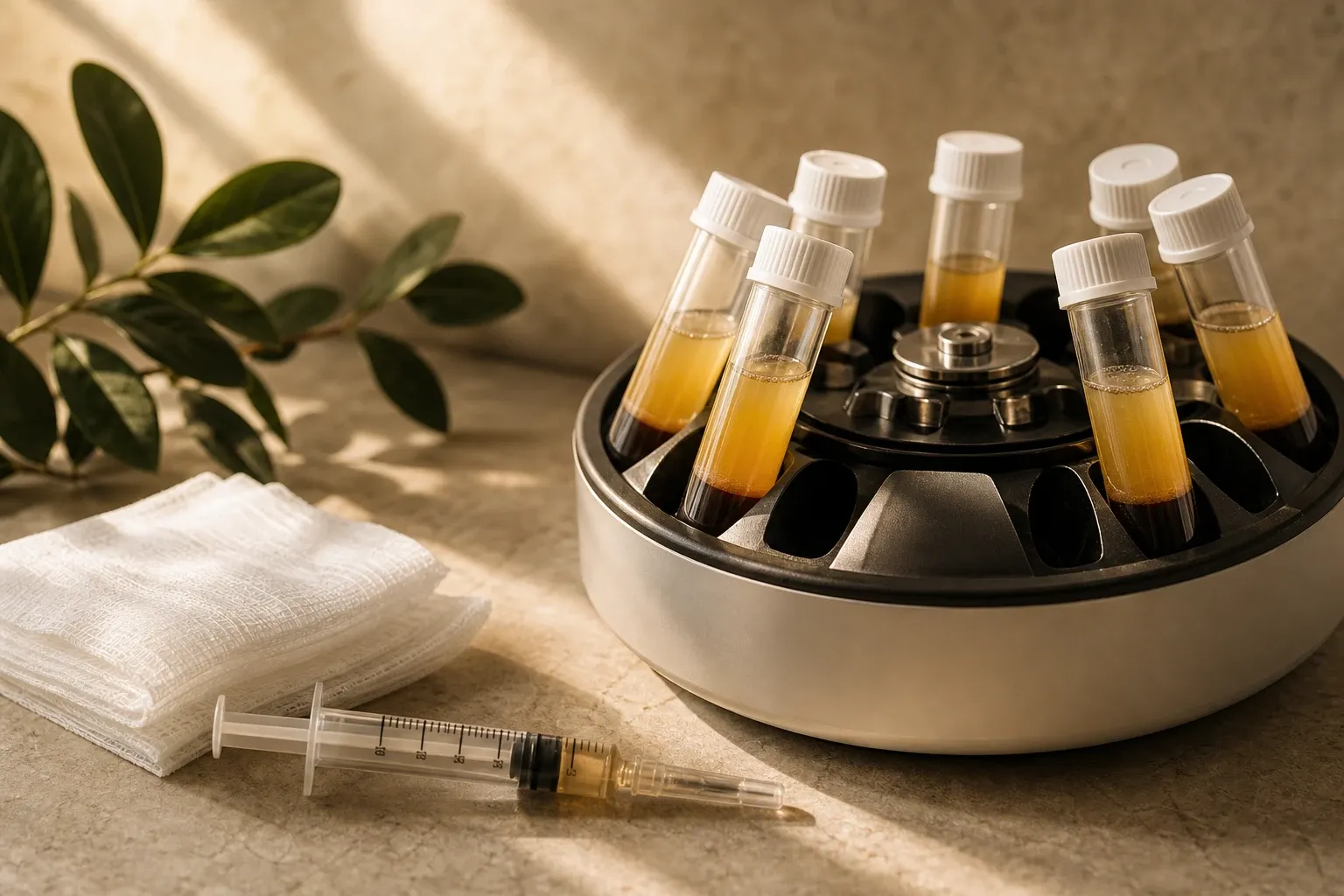
The sample spins for around ten minutes to separate concentrated plasma from red cells.
Scalp Injection
Your provider injects the plasma in a grid across thinning zones with a fine 30 gauge needle.
Aftercare and Scheduling
You book sessions two and three at monthly intervals before leaving the treatment room.
Risks and Side Effects
What You Should Know
Common PRP Side Effects
Scalp tenderness, tightness, mild swelling across the forehead, pinpoint bleeding and small bruises at the injection sites are expected and generally settle within 24 to 48 hours. Some patients get a short lived headache from the pressure of injecting fluid into the scalp. A temporary increase in shedding during the first weeks is common and is not a sign that treatment has failed.
Less Common Risks
Infection, persistent pain, injury to a nerve or blood vessel and calcification at an injection point are all uncommon but possible with any needle procedure. Because PRP comes from your own blood, allergic reaction to the material itself is not a concern, although the anesthetic or cleanser used can still cause a reaction.
Honest Limits and Regulatory Status
PRP is not FDA approved as a treatment for hair loss, and results vary widely between patients. Response is weaker where follicles have already scarred over. The FDA guidance on regenerative medicine therapies is worth reading before any clinic promises you guaranteed regrowth.
Investment
PRP Hair Treatment Cost
Pricing and Payment Options
How Much Does PRP Hair Treatment Cost?
PRP is priced per session, and almost nobody buys one session. The honest way to budget for it is as a course: three treatments a month apart, then maintenance roughly every six months to hold what you gained. Cost is driven by how many sessions your plan needs, the size of the area being treated and whether you add another therapy from our hair restoration treatments in Lake Havasu City. Exact pricing is discussed at your consultation.
Packages and Combination Plans
Because PRP is a series, we quote the initial three session course as a package rather than session by session, and we price maintenance visits separately once you reach that stage. Many patients combine PRP with scalp microneedling or with a topical regimen, and we build that into one plan so there are no surprises later.
Flexible Payment Options
We want the cost of a full course to be predictable rather than a surprise.
- Cherry - monthly payment plans with fast approval and no hard credit check to apply
- CareCredit - a healthcare credit line with promotional interest free periods
The Desert Oasis Way
Why Choose Desert Oasis Wellness and Med Spa for PRP Hair Treatment
Honest Assessment First
Our medical director brings more than 30 years of medical experience and 32 years in Lake Havasu City to every PRP session, with our nurse practitioner injector alongside her. If your follicles are already scarred over, they will tell you so before you book a series.
Nurse Practitioner Injectors
Two APRN injectors with 48 combined years of medical practice
Honest Candidacy Screening
We decline PRP when follicles are scarred or already gone
One Stop Shop
Hair restoration, hormones, injectables and labs under one roof
Photographed Progress
Fixed lighting scalp photos at baseline, month three and month six
Drawn And Spun Here
Your blood is processed on site and used within the hour
Comfort Measures Offered
Scalp numbing beforehand keeps the session easy to sit through




Explore More Related Treatments
Scalp Microneedling
Controlled micro-injury therapy that wakes up thinning follicles.
- No Surgery
- Better Uptake
- Minimal Downtime
Explore More Related Treatments
Hair Growth Treatments
Non-surgical scalp therapy, daily support and a six month clinical plan
- No Needles
- Zero Downtime
- Balanced Scalp
Explore More Related Treatments
Hormone Replacement Therapy
EvexiPEL pellets and HRT or TRT injections, guided by your own lab work.
- Steady Levels
- Four Options
- Precision Dosing
Explore More Related Treatments
Medical Weight Loss
Provider supervised GLP-1 injections paired with real nutritional guidance.
- Prescription
- Appetite Control
- Medical Oversight



Common Questions
Frequently Asked Questions About PRP Hair Treatment
How much does PRP hair treatment cost in Lake Havasu City?
How many PRP sessions do I need for hair loss?
Do PRP scalp injections hurt?
When will I see results from PRP hair treatment?
Does PRP hair treatment actually work?
Is PRP hair treatment FDA approved?
Is PRP better than minoxidil or finasteride?
Can women have PRP for hair loss?
How is this different from the Cellenis DermaPRP used with dermal fillers?
Who is not a good candidate for PRP hair treatment?
Can I combine PRP with scalp microneedling?
Is there downtime after PRP scalp injections?
Schedule Today Your PRP Hair Restoration Consultation
References
- Zhang et al., J Cutan Med Surg. (2023). Platelet-Rich Plasma for Androgenetic Alopecia: A Systematic Review and Meta-Analysis of Randomized Controlled Trials. PMID: 37533146.
- Gupta et al., Dermatol Ther. (2020). Platelet-rich plasma for androgenetic alopecia: Efficacy differences between men and women. PMID: 32761771.
- Kaiser et al., J Cutan Aesthet Surg. (2023). Platelet Rich Plasma Combination Therapies for Treatment of Androgenetic Alopecia: A Systematic Review. PMID: 38189076.
- Kaiser et al., Clin Cosmet Investig Dermatol. (2023). Treatment of Androgenetic Alopecia: Current Guidance and Unmet Needs. PMID: 37284568.
- Müller et al., An Bras Dermatol. (2023). Female-pattern hair loss: therapeutic update. PMID: 37003900.
- American Academy of Dermatology. (2024). Minoxidil and finasteride remain the FDA approved treatments for pattern hair loss, with platelet rich plasma used as an adjunct.