

Tox vs Microneedling vs Laser: Which Treatment Works Best for Your Skin?
Neurotoxin relaxes muscle, microneedling rebuilds collagen, and lasers target pigment and vessels. A Lake Havasu guide to telling which layer your skin needs treated.
Nearly every consultation at our Lake Havasu City office eventually lands on the same question: neurotoxin, microneedling or laser, and which one is best? It is a reasonable question with a slightly frustrating answer. These three are not competing versions of the same treatment. They work on three different layers of the face, and they solve three genuinely different problems.
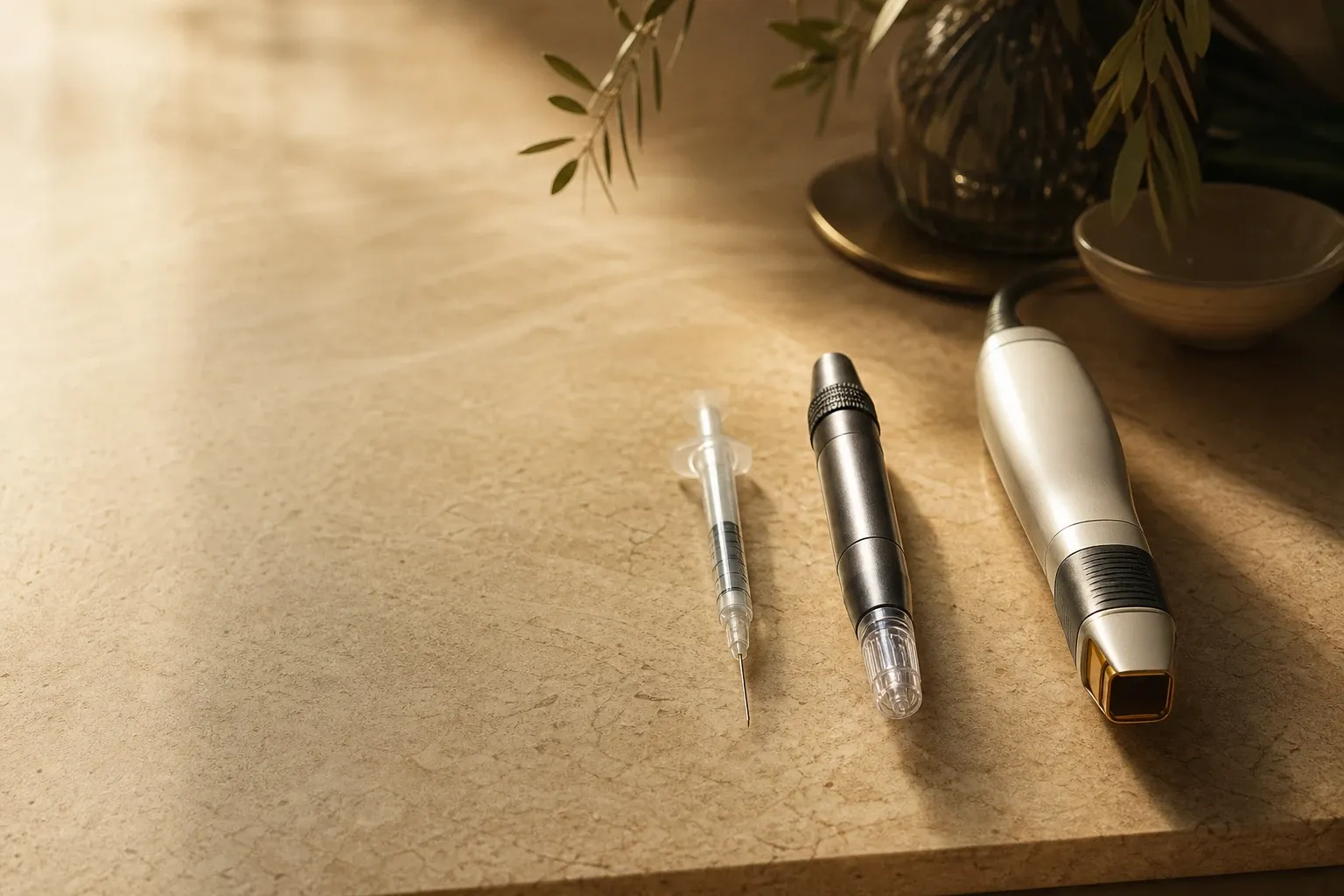
Neurotoxin quiets muscle movement. Microneedling rebuilds collagen. Lasers and light devices go after color: pigment, visible vessels and accumulated sun damage. Once you can tell which of those three your reflection is actually asking about, the choice gets much simpler, and the search for a single winner stops making sense.
Three treatments, three different targets
Before the details, here is the whole comparison in one look:
- Neurotoxin works at the muscle. It softens lines created by expression, and it does nothing for color or texture.
- Microneedling works in the dermis. It remodels collagen, so it improves texture, scarring and laxity, and it does nothing to muscle movement.
- Laser and light work on chromophores, the targets in skin that absorb light. That means brown spots, redness and broken capillaries, plus surface texture depending on the wavelength.
A person with deep forehead lines and clear, even skin needs something completely different from a person with smooth expression lines and a decade of desert sun on their cheeks. Same face, different layer.
Neurotoxin: turning down the muscle that folds the skin
Botulinum toxin type A temporarily blocks the nerve signal that tells a specific muscle to contract. When the muscle stops pulling, the skin above it stops folding, and the crease softens over the following days. It is the only one of these three treatments that addresses the cause of a line rather than the tissue quality around it.
That mechanism explains its narrow lane. Botox in Lake Havasu City works beautifully on frown lines between the brows, horizontal forehead lines and crow's feet, because those are dynamic wrinkles driven by repeated movement. It will not fade a sun spot, it will not fill a rolled acne scar, and it will not tighten loose skin along the jaw.
Results take roughly three to seven days to appear, settle at around two weeks, and generally last three to four months before the muscle gradually regains movement.
There is a useful test you can run on yourself in a mirror. Relax your face completely. If the line disappears when you are not making an expression, it is dynamic, and neurotoxin is the right tool. If it stays etched into resting skin, the crease has become a structural change in the dermis, and you have moved into microneedling and laser territory.
Microneedling: rebuilding structure under the surface
Microneedling uses fine needles to create controlled micro-injuries in the dermis. The body reads those channels as damage and responds with its normal repair cascade, releasing growth factors and signalling fibroblasts to lay down fresh collagen and elastin. Nothing is removed and nothing is added. You are borrowing the body's own repair response and pointing it at the areas you want rebuilt.
Modern versions add radiofrequency energy through the needle tips, which is a meaningful upgrade rather than a marketing one. Heat delivered at depth causes existing collagen to contract immediately and drives a longer remodeling response over the following months. RF microneedling with the Exion platform is our workhorse for texture, enlarged pores, early laxity and fine lines, with the device reading tissue response in real time and adjusting energy as it moves from thin under-eye skin to thicker jawline tissue.
When the concern runs deeper, particularly laxity along the jawline and neck or well established acne scarring, we reach for Morpheus8 fractional radiofrequency, which places insulated needles down to roughly four millimeters and heats the dermis and the fat layer beneath it.
Either way, this is a patient treatment. Expect a series of three to four sessions spaced about a month apart, mild redness for a day or two afterwards, and results that continue building for three to six months as new collagen matures.
Laser and light: treating color rather than movement or structure
Lasers work on a principle called selective photothermolysis. A specific wavelength is absorbed preferentially by a specific target, so energy is deposited into that target and largely spares the tissue around it. Melanin absorbs certain wavelengths, hemoglobin absorbs others, and water absorbs others still.
This is why laser is the answer for problems you can see but cannot feel: brown patches, freckling across the cheeks, persistent facial redness and the fine vessels that map across the nose.
It is also why laser is not one treatment. Our laser and light menu in Lake Havasu City covers several devices because pigment, vascular concerns, unwanted hair and surface texture each need different energy delivered in different ways. Matching the device to the target matters more than choosing the most powerful machine in the room.
For skin of color, and for anyone who has been told their complexion is too deep for laser, Aerolase 1064nm treatment is worth understanding. Its 650 microsecond pulse is brief enough to heat a target without letting heat spread into surrounding tissue, which is what makes it well tolerated across the full range of skin tones.
Nothing touches the skin, sessions run fifteen to thirty minutes, and most people return to normal activity the same day.
Side by side
| Attribute | Neurotoxin | Microneedling | Laser and light |
|---|---|---|---|
| Layer treated | Muscle | Dermis | Pigment, vessels and surface |
| What it fixes | Lines caused by expression | Texture, scarring, pores, laxity | Sun spots, redness, vessels, tone |
| What it will not fix | Color, texture, laxity | Muscle movement, pigment | Muscle movement, deep volume loss |
| Session length | 10 to 20 minutes | 30 to 60 minutes after numbing | 15 to 45 minutes |
| When results show | 3 to 7 days, settled at 2 weeks | Gradual, peaking at 3 to 6 months | Days to a few weeks per session |
| Typical downtime | None, small bumps settle within the hour | 1 to 3 days of redness | None to a few days depending on device |
| Sessions needed | One, repeated seasonally | 3 to 4, roughly monthly | 1 to 6 depending on the concern |
| Maintenance | Every 3 to 4 months | Touch-up once or twice a year | Annual, plus daily sun protection |
| Collagen effect | None | Primary mechanism | Secondary, varies by device |
How to work out which one your skin is asking for
Watch the line when your face is at rest
Dynamic lines that vanish at rest belong to neurotoxin. Static lines that remain when the face is still belong to collagen work. Many people have both, which is why so many treatment plans include both.
Decide whether the problem is color or texture
Close your eyes and run a fingertip across the area. If you can feel the concern, as roughness, indentation or slackness, it is structural and microneedling is the better fit. If you can only see it, as a brown patch, a flush of redness or a thread vein, it is chromatic and light based treatment is the better fit.
Be honest about downtime
Neurotoxin fits into a lunch break. Aerolase and most light treatments cost you very little visible recovery. Radiofrequency microneedling asks for a day or two where you may not want to be photographed, and deeper Morpheus8 settings ask for slightly more. None of these require you to disappear for a month, but the planning is different.
Why these treatments are so often combined
Because they act on separate layers, they stack rather than overlap. A common plan pairs collagen work with neurotoxin: the microneedling series rebuilds the quality of the skin over several months while neurotoxin keeps the muscles from re-etching the lines you are working to soften. Adding a pigment or vascular treatment on top clears the discoloration that neither of the other two would have touched.
Sequencing matters more than most people expect. We usually schedule collagen work first and place neurotoxin one to two weeks afterwards, so injected product is not disturbed by the pressure and micro-trauma of a needling session. Energy based treatments are spaced out rather than stacked in one visit, so skin has time to complete its repair cycle before it is asked to start another. Your provider will build that calendar with you at consultation.
The Lake Havasu factor
Living here changes the arithmetic. Cumulative ultraviolet exposure breaks down dermal collagen and drives pigment production, so people in this climate often present with a combination of etched static lines, uneven tone and visible vessels well before they expect to. That pattern is rarely solved by one modality, and it is genuinely undone by inconsistent sun protection.
Daily broad spectrum sunscreen is not an upsell after any of these treatments. It is the thing that protects the result you paid for, especially after laser work, when treated skin is temporarily more sensitive to light.
References
- Carruthers et al., Aesthet Surg J. (2016). OnabotulinumtoxinA for Treatment of Moderate to Severe Crow's Feet Lines: A Review. PMID: 26979457.
- Alexiades et al., Facial Plast Surg Clin North Am. (2023). Radiofrequency Microneedling. PMID: 37806682.
- Shen et al., Aesthetic Plast Surg. (2022). Microneedling Monotherapy for Acne Scar: Systematic Review and Meta-Analysis of Randomized Controlled Trials. PMID: 35426044.
- Tanaka et al., Lasers Surg Med. (2016). Objective assessment of intensive targeted treatment for solar lentigines using intense pulsed light with wavelengths between 500 and 635 nm. PMID: 26462982.
- Lee et al., Photodermatol Photoimmunol Photomed. (2024). The efficacy and safety of low- versus high-fluence fractional picosecond Nd:YAG 1064-nm laser in the treatment of acne scars: A randomized split-face comparison study. PMID: 37898983.
Frequently Asked Questions
Which one gives the fastest visible result?
Neurotoxin, comfortably. Most people see softening within three to seven days and the final result at about two weeks. Light based treatments for pigment often show change within a week of a session. Microneedling is the slow one by design, because you are waiting on your own collagen to be built and mature, which takes months rather than days.
Can I have more than one of these in the same visit?
Sometimes, but not as a default. Combining treatments in one appointment depends on the areas involved, your skin's sensitivity and how much recovery you can absorb at once. More often we space them across a plan, since each one asks the skin to complete a repair cycle. Your provider will map the order at consultation.
Is microneedling or laser better for acne scars?
It depends on the scar. Depressed and rolling scars are structural, so radiofrequency microneedling and Morpheus8 tend to be the stronger choice because they rebuild collagen underneath the indentation. Flat scars that are mainly discoloration, whether brown or red, respond better to light based treatment. Many people with mixed scarring benefit from both, addressed in sequence.
Do any of these work on deeper skin tones?
Yes. Neurotoxin and microneedling are not affected by skin tone, and Aerolase was chosen specifically because its 1064nm wavelength and very short pulse are well tolerated across the full range of complexions. Some older light devices carry more risk of pigment change in richer skin tones, which is exactly why device selection is part of the consultation rather than an afterthought.
How much do these treatments cost?
Pricing depends on the treatment, the areas covered and how many sessions your plan calls for, so we quote it at consultation rather than in advance. Desert Oasis Wellness and Med Spa offers financing through Cherry and CareCredit if you would rather spread the cost of a treatment series.
Which should I start with if I am in my thirties and want to age well?
For most people the honest answer is consistent sun protection plus whichever modality matches the concern that bothers you most today. Neurotoxin used early keeps developing expression lines from etching in. Collagen work maintains the quality of the skin as production naturally declines. Neither substitutes for the other, and there is no urgency to do all three at once.
If you are still unsure which of these three your skin actually needs, that is exactly what a consultation is for. Desert Oasis Wellness and Med Spa in Lake Havasu City will assess your skin in person, explain which layer your concern lives in, and build a plan around it. Call (928) 889-0155 to book, or visit us at 2010 Injo Drive, Monday through Friday, 7:00 AM to 4:00 PM.